

Explore Our Methodology
The Digital Trust & AI Readiness Methodology helps organizations assess and improve their ability to safely participate in the digital economy.
Our framework evaluates six critical domains:
- Governance & Leadership
- Data Protection & Privacy
- AI Readiness & Responsible Use
- Operational Risk & Compliance
- Vendor Governance
- Organizational Readiness & Culture
DTAR™ Core Six Domains
HOW IT WORKS

Step One: Digital Trust Assessment
Complete the Digital Trust & AI Readiness Assessment

Step Two: Analyze
Receive your DTAR™ Score and maturity profile

Step Three: Improve
Follow a customized roadmap to strengthen governance, resilience, and responsible AI adoption.
OUR CLIENTS
- Small and Mid-Sized Businesses
- Healthcare Providers
- Professional Service Firms
- Construction Companies
- Technology Startups
- Multi-State and International Businesses
Building Digital Trust, Readiness, and Resilience
The Digital Trust & AI Readiness Methodology (DTARM™) is a practical assessment and improvement framework designed to help small and mid-sized organizations evaluate and strengthen their ability to operate safely, responsibly, and effectively in today’s digital environment.
As businesses increasingly rely on artificial intelligence, cloud platforms, digital vendors, and data-driven operations, they face growing challenges related to governance, privacy, operational risk, and organizational readiness.
DTARM™ provides a structured approach to assessing these challenges and transforming them into actionable improvement opportunities.
How DTAR™ Delivers Value
DTAR™ Assessment
Domain Questions
The Assessment measures an organization’s maturity across six key areas that shape digital trust, responsible technology adoption, and long-term business resilience.
DTAR™ Results
Domain Score
Each domain receives an individual score, which contributes to the overall DTAR™ Score
DTAR™ Roadmap
Project Roadmap
DTAR™ builds information based on strengths, gaps, risks, and improvement priorities while generating a practical roadmap for organizational growth and digital readiness.
DTAR™ Core Six Domains
Explore how our DTAR™ framework evaluates digital trust, AI readiness, governance maturity, and resilience to empower SMEs effectively.
1
Governance & Leadership
Assesses whether leaders define responsibilities, accountability, decision-making, and oversight for digital operations, data management, and emerging technologies effectively.
Key Areas Evaluated
- Leadership accountability
- Governance responsibilities
- Policy oversight
- Strategic decision-making
- Executive reporting
- Continuous improvement
4
Operational Risk & Compliance
Evaluates the organization’s ability to recognize, assess, document, and mitigate operational, regulatory, and technology-related risks.
Key Areas Evaluated
- Risk identification
- Internal controls
- Compliance practices
- Monitoring activities
- Corrective actions
- Continuous improvement
2
Data Protection & Privacy
Assesses how effectively the organization identifies, classifies, controls, and protects information assets and personal data throughout their lifecycle.
Key Areas Evaluated
- Data inventory
- Data classification
- Access management
- Data retention practices
- Data sharing controls
- Incident preparedness
5
Third-Party & Vendor Governance
Assesses how effectively the organization manages third-party risks, vendor relationships, oversight, compliance, security, and resilience.
Key Areas Evaluated
- Vendor inventories
- Risk classification
- Due diligence
- Contract oversight
- Access management
- Vendor monitoring
3
AI Readiness & Responsible Use
Assesses how organizations govern, monitor, document, and manage AI systems and tools across operational activities, workflows, and decision-making processes effectively.
Key Areas Evaluated
- AI inventory and visibility
- AI governance policies
- Responsible use practices
- Human oversight
- Risk assessment
- Monitoring and review
6
Workforce Readiness & Culture
Assesses organizational awareness, training, communication, and cultural readiness related to governance, data protection, and responsible tech use.
Key Areas Evaluated
- Data inventory
- Data classification
- Access management
- Data retention practices
- Data sharing controls
- Incident preparedness
DTAR™ Scores
Upon completion of the assessment, organizations receive a Digital Trust & AI Readiness Score (DTAR™) ranging from 0 to 100.
High Risk
0–30
Significant governance and readiness gaps require immediate attention.
Advanced
71–85
The organization demonstrates strong digital governance capabilities.
Developing
31–50
Basic practices exist but require formalization and improvement.
Trusted
86–100
The organization exhibits mature governance, readiness, and resilience practices.
Managed
51–70
Core governance and operational controls are in place.
DTAR™ Products and Services
- Digital Trust Score™
- Executive Summary Report
- Risk Heatmap
- Mature Profile
- 90-Day Governance Roadmap
- 180-Day Governance Roadmap
- Improvement and Priority Recommendations
- Benchmark Insights
- Month Improvement Plan
Discover the DTAR™ Methodology Advantages
Unlike traditional compliance programs, DTAR™ focuses on organizational readiness and practical implementation.
Our goal is not simply to help organizations comply with requirements.
Our goal is to help organizations:
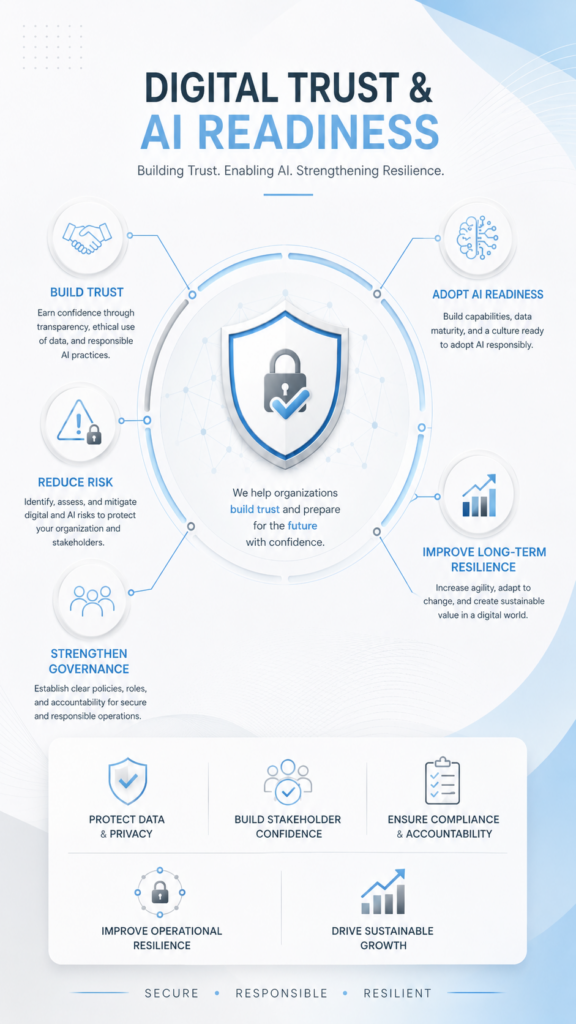
Build Trust
Foster trust through enhanced transparency, accountability, data protection, and responsible tech practices to boost confidence, mitigate risks, and build lasting relationships.
Reduce Risk
Reduce risk through stronger controls, proactive governance, and informed decision-making.
Strengthen Governance
Strengthen governance through clear accountability, effective policies, and responsible decision-making.
Adopt AI Responsibly
Adopt AI responsibly through ethical practices, transparency, accountability, and effective oversight.
Improve Long-Term Resilience
Improve long-term resilience through adaptability, preparedness, and sustainable strategies.